AAU’s Faculty of Engineering Participates in the Second Red Sea Ecosphere Conference with a Research Paper on Enhancing Coastal Ecosystem Resilience
The Faculty of Engineering at Amman Arab University (AAU) continues to strengthen its academic and research presence at specialized international conferences and academic forums through its participation in the Second Red Sea Ecosphere Conference, which will be held in Aqaba from November 26–28, 2027.
The Faculty will participate by presenting a research paper entitled:
“Integrating Long-Term Environmental Monitoring with Adaptive Governance for Resilient Coastal Ecosystems in Jordan’s Red Sea Region.” The participation reflects the Faculty’s commitment to engaging in international scientific events, exchanging knowledge and expertise, and contributing innovative and sustainable solutions to environmental and engineering challenges.
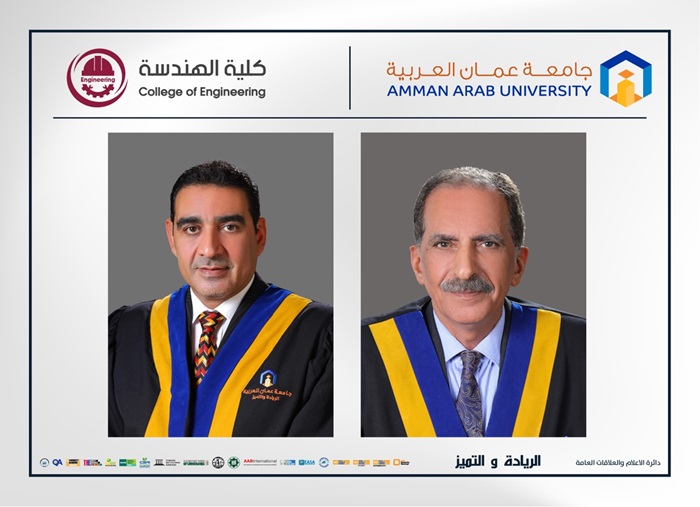
The research was prepared by Dr. Anwar Al-Assaf, Dean of the Faculty of Engineering and a faculty member in the Department of Renewable Energy Engineering, and Dr. Omar Ahmad from the Department of Civil Engineering.
The study highlights the importance of developing an integrated framework that combines long-term environmental monitoring with adaptive governance to enhance the resilience of coastal ecosystems in the face of growing environmental and climate-related challenges.
It examines the key challenges facing Jordan’s Red Sea coastal region, particularly climate change, marine pollution, biodiversity degradation, and rapid coastal urban expansion. These challenges underscore the need for more integrated and sustainable approaches to managing marine and coastal environments.
The proposed framework brings together a range of scientific components, including coral reef health assessments, seawater quality monitoring, coastal geomorphological studies, biodiversity dynamics monitoring, and pollution-level assessment. It also incorporates modern technologies, such as remote sensing, unmanned aerial systems (UAS), and environmental sensors, to collect high-resolution data and enable continuous monitoring of environmental changes.
The proposed framework focuses on evidence-based decision-making, the application of adaptive governance principles, stakeholder engagement, and knowledge sharing. This approach seeks to connect scientific monitoring and research findings with decision-making processes and environmental policy development, while strengthening cooperation among institutions and stakeholders involved in marine environmental protection.
The implementation of this model is expected to deliver a range of benefits, including protecting marine ecosystems and coral reefs, promoting sustainable coastal management, enhancing resilience to the impacts of climate change, supporting evidence-based environmental policies, and strengthening regional cooperation in marine environmental protection.
This participation reaffirms the Faculty of Engineering at Amman Arab University’s commitment to supporting applied scientific research and connecting academic knowledge with local environmental and developmental challenges. It also reflects the University’s efforts to strengthen its presence at specialized scientific conferences and highlight the contributions of its researchers toward developing sustainable solutions that protect natural resources and enhance the resilience of coastal environments in the face of climate change and environmental pressures.