Amman Arab University (AAU) Participates in the International Conference on Intelligent Information Systems and Computing (IISCC 2026) in the United Arab Emirates
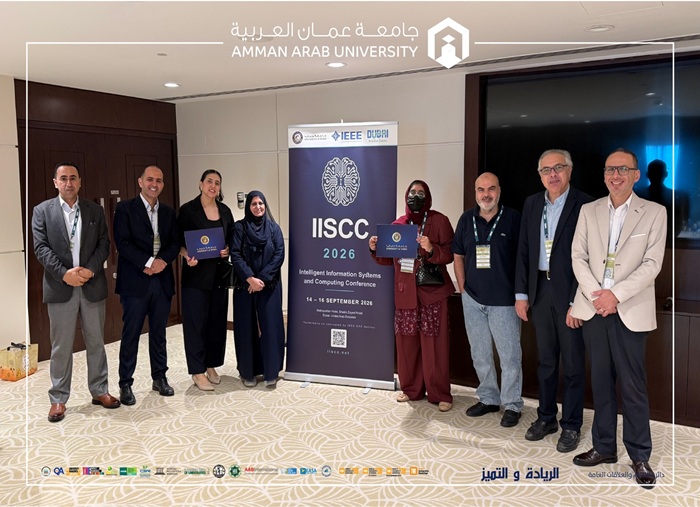
Amman Arab University participated in the International Conference on Intelligent Information Systems and Computing (IISCC 2026), held in the United Arab Emirates, with the participation of researchers and academics from more than 31 countries, in cooperation with the global IEEE organization. The conference reflects the University’s academic and research presence at international scientific forums and strengthens its engagement in the fields of intelligent information systems and computing.
Amman Arab University was represented at the conference by Dr. Tareq Al-Bashtawi and Dr. Ayman Ghaban, faculty members at the Faculty of Information Technology. Their participation aligns with the University’s vision and mission of supporting applied scientific research and strengthening international partnerships. During the conference, they presented a number of specialized research papers addressing topics in artificial intelligence, cybersecurity, and digital technologies.
During the conference, Dr. Al-Bashtawi presented two research papers addressing emerging topics in artificial intelligence, cybersecurity, and renewable energy.
The first paper, co-authored with Dr. Ayman Ghaban, was entitled “Comparison of Machine Learning Mechanisms for Detecting Fake Platform Accounts on Microsoft Teams, Zoom, and Webex.” The study focused on using machine learning algorithms to detect fake accounts on virtual collaboration platforms such as Microsoft Teams, Zoom, and Webex. It also compared the performance of several algorithms with the aim of improving the accuracy of fraudulent-account detection and reducing the associated cybersecurity risks.
The second paper, entitled “Explainable AI for Smart Renewable Energy Decision-Making,” proposed an Explainable Artificial Intelligence (XAI) framework aimed at enhancing transparency and trust in renewable energy forecasting and improving energy distribution mechanisms. The proposed framework combines advanced machine learning models with explainability techniques to generate more reliable and understandable predictions, thereby supporting smart and effective decision-making in renewable energy management.
For his part, Dr. Ayman Ghaban presented a research paper entitled “Permissions Hacking as a Security Challenge on Social Media: Facebook, YouTube, Instagram and Snapchat.” The study examined security challenges resulting from the exploitation of excessive or improperly configured permissions, which may allow attackers to compromise social media accounts and gain access to users’ data.
The study compared several social media platforms, including Facebook, YouTube, Instagram, and Snapchat, and examined the main attack methods and security vulnerabilities associated with them, along with measures for protection and mitigating the risks of permission exploitation. The study emphasized the importance of strengthening permission-management mechanisms, enhancing security measures, and developing frameworks for security cooperation among social media platforms, developers, and users.
The research papers presented at the conference are scheduled to be published in the global Scopus database, reflecting the academic value of these research contributions and the significance of the conference in the fields of intelligent systems, computing, and emerging technologies.
In this regard, Dr. Rami Sahwail, Dean of the Faculty of Information Technology at Amman Arab University, emphasized the importance of active participation by faculty members in international scientific conferences, given the opportunities they provide to learn about the latest developments and practices in artificial intelligence and digital technology.
He noted that such participation enables academic staff to exchange expertise with researchers and specialists locally and internationally, while strengthening the University’s role in supporting scientific research and innovation and keeping pace with the rapid developments in modern technologies, particularly in the fields of artificial intelligence and cybersecurity.
Amman Arab University’s participation in this conference reflects its commitment to strengthening its academic presence at international scientific forums and supporting its faculty members in staying up to date with developments in cybersecurity, artificial intelligence, and modern digital technologies. These efforts contribute to developing their skills, broadening their knowledge, and keeping pace with the rapid advancements taking place in this vital field.