AAU Engineering Presents a Research Proposal to the Ministry of Energy and Mineral Resources to Convert Cattle Waste into a Sustainable Energy Source
In line with Amman Arab University’s vision of strengthening effective partnerships and integration with ministries and national institutions, and aligning scientific research with the needs of Jordan’s vital sectors, the Faculty of Engineering has submitted a research proposal to the Ministry of Energy and Mineral Resources aimed at harnessing organic waste from cattle farms and converting it into an alternative and sustainable energy source. The initiative is being pursued under the guidance of Professor Mohammad Al-Widyan, President of Amman Arab University, and with the follow-up and support of Dr. Anwar Al-Assaf, Dean of the Faculty of Engineering, as part of the Faculty’s commitment to supporting innovative student projects and transforming ideas into practical, real-world solutions.
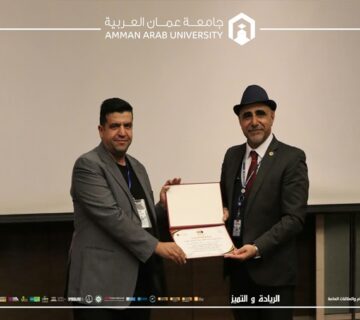
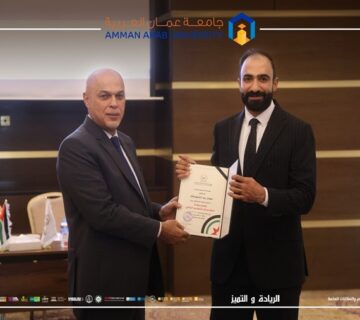
The project, entitled “A Design, Thermodynamic Modeling, and Techno-Economic Feasibility of an Advanced Bovine Bio-Refinery for a Scalable Dairy Operation,” was presented to the relevant committee at the Ministry by Eng. Shahd Al-Mawas, the Ministry’s liaison officer, with the participation of Abdulrahman Al-Atiyat, a student in the Renewable Energy Engineering Department.
The project employs anaerobic digestion technology to convert organic waste generated by cattle farms into biogas, which can be used to generate electricity and thermal energy. It also examines the thermodynamic performance of the process, assesses the project’s techno-economic feasibility, and explores its potential implementation and scalability across large-scale cattle farms in Jordan. In addition, the project investigates the potential use of the residual material produced through the treatment process as organic fertilizer.
If implemented, the proposed approach is expected to help reduce pollution and emissions associated with organic waste, improve resource efficiency, and advance the principles of the circular economy and sustainable energy. It also offers opportunities to apply innovative engineering solutions in support of Jordan’s productive and environmental sectors.
In this regard, Dr. Al-Assaf emphasized the importance of supporting innovative engineering projects that respond to the needs of society and national sectors. He affirmed the Faculty of Engineering’s commitment to encouraging creative ideas and developing them into practical solutions that address environmental and economic challenges. He further noted that the project represents a practical example of how engineering technologies can be used to convert animal waste into energy, helping reduce costs, enhance sustainability, and support Jordan’s transition toward renewable energy and a green economy.
Eng. Al-Mawas affirmed that the project aligns with the Ministry of Energy and Mineral Resources’ efforts to promote innovation and scientific research in renewable energy, while developing sustainable solutions for organic waste management and harnessing such waste as a clean and efficient energy source. She noted that this approach can contribute to improving resource efficiency and supporting the transition toward a more sustainable economy.
For his part, Abdulrahman Al-Atiyat explained that the project integrates environmental and economic objectives by reducing emissions and pollution resulting from cattle farm waste while providing a sustainable energy source for electricity generation and heating within farms. He also highlighted the potential to utilize the residual material from anaerobic digestion in the production of organic fertilizers.
The project attracted the attention of the relevant committee at the Ministry of Energy and Mineral Resources, which discussed its development prospects and potential for practical implementation. The proposed initiative offers promising opportunities to develop practical and sustainable solutions for energy production and waste management in Jordan’s agricultural sector.